Calendar months and days origin
Description[1]
Calendar from Middle English calender, Latin calendarium (account book). The Romans called the first day of each month Kalendae, or calends. Debts were due on this day, so books to track payments were called calendarium from which we get our modern day calendar.
The Gregorian calendar is the most widely used civil calendar in the world. It is named after Pope Gregory XIII, who introduced it in October 1582. The calendar spaces leap years to make the average year 365.2425 days long, approximating the 365.2422 day tropical year that is determined by the Earth's revolution around the Sun.
The calendar was developed as a refinement of the Julian calendar, shortening the average year by 0.0075 days to stop the drift of the calendar with respect to the equinoxes. To deal with the 10 days of accumulated drift, the date was advanced so that 4 October 1582 was followed by 15 October 1582. There was no discontinuity in the cycle of weekdays or of the Anno Domini calendar era .
The Gregorian calendar is a solar calendar with 12 months of 28-31 days each. A regular Gregorian year consists of 365 days, but in certain years known as leap years, a leap day is added to February. Gregorian years are identified by consecutive year numbers. A calendar date is fully specified by the year (numbered according to a calendar era, in this case Anno Domini or Common Era), the month (identified by name or number), and the day of the month (numbered sequentially starting from 1).
Due to globalization in the 20th century, the calendar has also been adopted by most non-European countries for civil purposes.
Months[2]
The original Roman year had 10 named months:

- Martius "March"
- Aprilis "April"
- Maius "May"
- Junius "June"
- Quintilis "July"
- Sextilis "August"
- September "September"
- October "October"
- November "November"
- December "December"
| Month | Name | Etymology | Eponynm | Days |
|---|---|---|---|---|
| January | Janus' month | Middle English Januarie Latin Januarius "of Janus" Latin Janu(s) "Janus" + -arius "ary (pertaining to)" Latin Januarius mensis "month of Janus" |
Janus is the Roman god of gates and doorways, depicted with two faces looking in opposite directions. His festival month is January. |
Januarius had 29 days, until Julius when it became 31 days long. |
| February | month of Februa | Middle English Februarius Latin Februarius "of Februa" Latin Februa(s) "Februa" + -arius "ary (pertaining to)" Latin Februarius mensis "month of Februa" Latin dies februatus "day of purification" |
Februa is the Roman festival of purification, held on February fifteenth. It is possibly of Sabine origin. |
Februarius had 28 days, until circa 450 BC when it had 23 or 24 days on some of every second year, until Julius when it had 29 days on every fourth year and 28 days otherwise. |
| March | Mars' month | Middle English March(e) Anglo-French March(e) Old English Martius Latin Martius "of Mars" Latin Marti(s) "Mars" + -us (adj. suffix) Latin Martius mensis "month of Mars" |
Mars is the Roman god of war. He is identified with the Greek god Ares. |
Martius has always had 31 days. March was the original beginning of the year, and the time for the resumption of war. |
| April | Aphrodite's month | Old English April(is) Latin Aprilis Etruscan Apru Greek Aphro, short for Aphrodite. |
Aphrodite is the Greek goddess of love and beauty. She is identified with the Roman goddess Venus. |
Aprilis had 30 days, until Numa when it had 29 days, until Julius when it became 30 days long. |
| May | Maia's month | Old French Mai Old English Maius Latin Maius "of Maia" Latin Maius mensis "month of Maia" |
Maia (meaning "the great one") is the Italic goddess of spring, the daughter of Faunus, and wife of Vulcan. |
Maius has always had 31 days. |
| June | Juno's month | Middle English jun(e) Old French juin Old English junius Latin Junius "of Juno" Latin Junius mensis "month of Juno" |
Juno is the principle goddess of the Roman Pantheon. She is the goddess of marriage and the well-being of women. She is the wife and sister of Jupiter. She is identified with the Greek goddess Hera. |
Junius had 30 days, until Numa when it had 29 days, until Julius when it became 30 days long. |
| July | Julius Caesar's month | Middle English Julie Latin Julius "Julius" Latin Julius mensis "month of Julius" Latin quintilis mensis "fifth month" |
Julius Caesar reformed the Roman calendar (hence the Julian calendar) in 46 BC. In the process, he renamed this month after himself. |
Quintilis (and later Julius) has always had 31 days. |
| August | Augustus Caesar's month | Latin Augustus "Augustus" Latin Augustus mensis "month of Augustus" Latin sextilis mensis "sixth month" |
Augustus Caesar clarified and completed the calendar reform of Julius Caesar. In the process, he also renamed this month after himself. |
Sextilis had 30 days, until Numa when it had 29 days, until Julius when it became 31 days long. |
| September | the seventh month | Middle English septembre Latin September Latin septem "seven" + -ber (adj. suffix) Latin september mensis "seventh month" |
September had 30 days, until Numa when it had 29 days, until Julius when it became 30 days long. |
|
| October | the eighth month | Middle English octobre Latin October Latin octo "eight" + -ber (adj. suffix) Latin october mensis "eighth month" |
October has always had 31 days. | |
| November | the nineth month | Middle English Novembre Latin November Latin Novembris mensis "nineth month" |
Novembris had 30 days, until Numa when it had 29 days, until Julius when it became 30 days long. |
|
| December | the tenth month | Middle English decembre Old French decembre Latin december "tenth month" Latin decem "ten" + -ber (adj. suffix) |
December had 30 days, until Numa when it had 29 days, until Julius when it became 31 days long. |
Days[3]
The English words for each day bear remnants of Roman tradition, but they have been filtered through centuries of Germanic and Norse mythos.
The Germanic people adapted the Roman system by identifying Roman gods with their own deities.
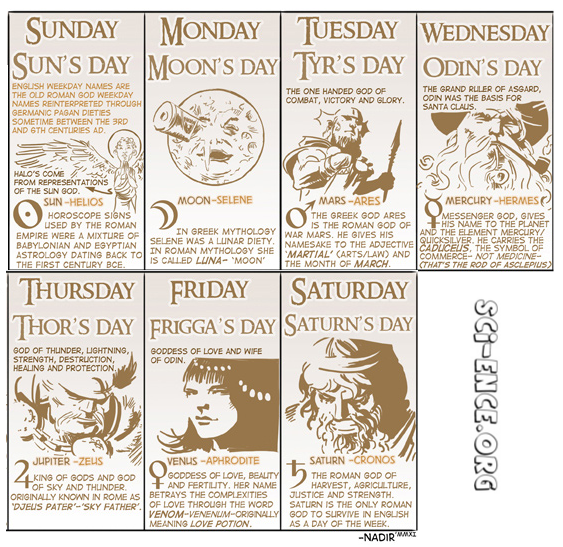
| Day | Eponym | Etymology |
|---|---|---|
| Sunday | Sun's day | Old English "Sunnandæg," which is derived from a Germanic interpretation of the Latin dies solis, "sun's day." Germanic and Norse mythology personify the sun as a goddess named Sunna or Sól. |
| Monday | Moon's day | Old English "Mōnandæg," named after Mani, the Norse personification of the moon (and Sól's brother). |
| Tuesday | Tyr's day | Old English "Tīwesdæg," after Tiw, or Tyr, a one-handed Norse god of dueling. He is equated with Mars, the Roman war god. |
| Wednesday | Odin's day | "Wōden's day." Wōden, or Odin, was the ruler of the Norse gods' realm and associated with wisdom, magic, victory and death. The Romans connected Wōden to Mercury because they were both guides of souls after death. "Wednesday" comes from Old English "Wōdnesdæg." |
| Thursday | Thor's day | "Thor's day," gets its English name after the hammer-wielding Norse god of thunder, strength and protection. The Roman god Jupiter, as well as being the king of gods, was the god of the sky and thunder. "Thursday" comes from Old English "þūnresdæg." |
| Friday | Frigga's day | Named after the wife of Odin. Some scholars say her name was Frigg; others say it was Freya; other scholars say Frigg and Freya were two separate goddesses. Whatever her name, she was often associated with Venus, the Roman goddess of love, beauty and fertility. "Friday" comes from Old English "Frīgedæg." |
| Saturday | Saturn's day | Germanic and Norse traditions didn't assign any of their gods to this day of the week. They retained the Roman name instead. The English word "Saturday" comes from the Anglo-Saxon word "Sæturnesdæg," which translates to "Saturn's day." |
References
- ^ Gregorian calendar. https://en.wikipedia.org/wiki/Gregorian_calendar
- ^ Months. https://www.crowl.org/Lawrence/time/months.html
- ^ Days. https://www.livescience.com/45432-days-of-the-week.html