A seismic scale is used to describe the strength or "size" of an earthquake. There are two types of scales: intensity scales that describe the intensity or severity of ground shaking (quaking) at a given location, and magnitude scales that measure the strength of the seismic event itself, usually based on an instrumental record. The intensity and nature of ground shaking depends on the local geology; at a given locality the intensity of shaking depends on the magnitude and distance of the seismic event.
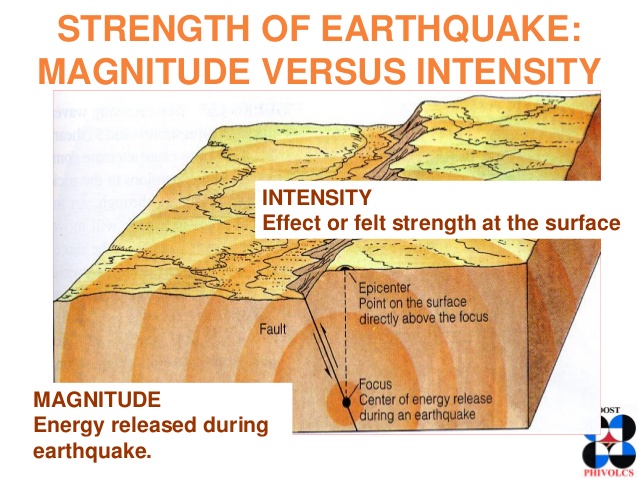
Magnitude and Intensity measure different characteristics of earthquakes.
Magnitude measures the energy released at the source of the earthquake. A quantitative measure of the actual size of the earthquake. It is determined from measurements on seismographs. It is denoted by M(number) e.g. M8 or M6.5.
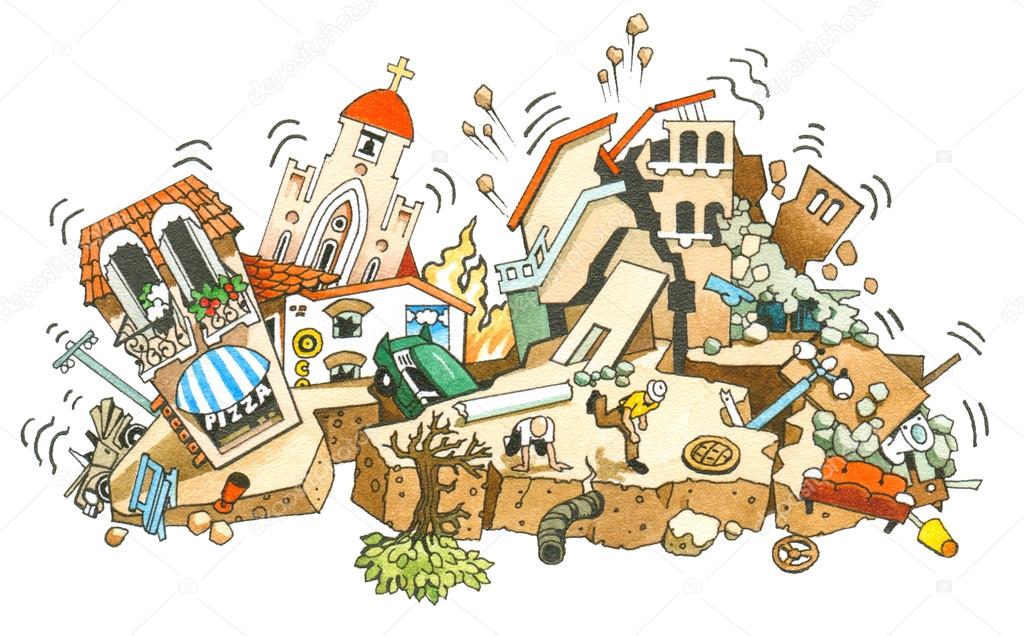
Intensity measures the strength of shaking produced by the earthquake at a certain location. An indicator of the severity of shaking generated at a given location. It is determined from effects on people, human structure and the natural environment. Severity of shaking is much higher near the epicenter than farther away. It varies at each and every place. It is represented by Roman numerals (e.g. II, IV, IX).
They are not positively correlated. Greater magnitude does not necessarily means greater intensity.
Unlike magnitude scales, intensity scales do not have a mathematical basis; instead they are an arbitrary ranking based on observed effects. Most seismic intensity scales have twelve degrees of intensity and are roughly equivalent to one another in values but vary in the degree of sophistication employed in their formulation.
Magnitude scale
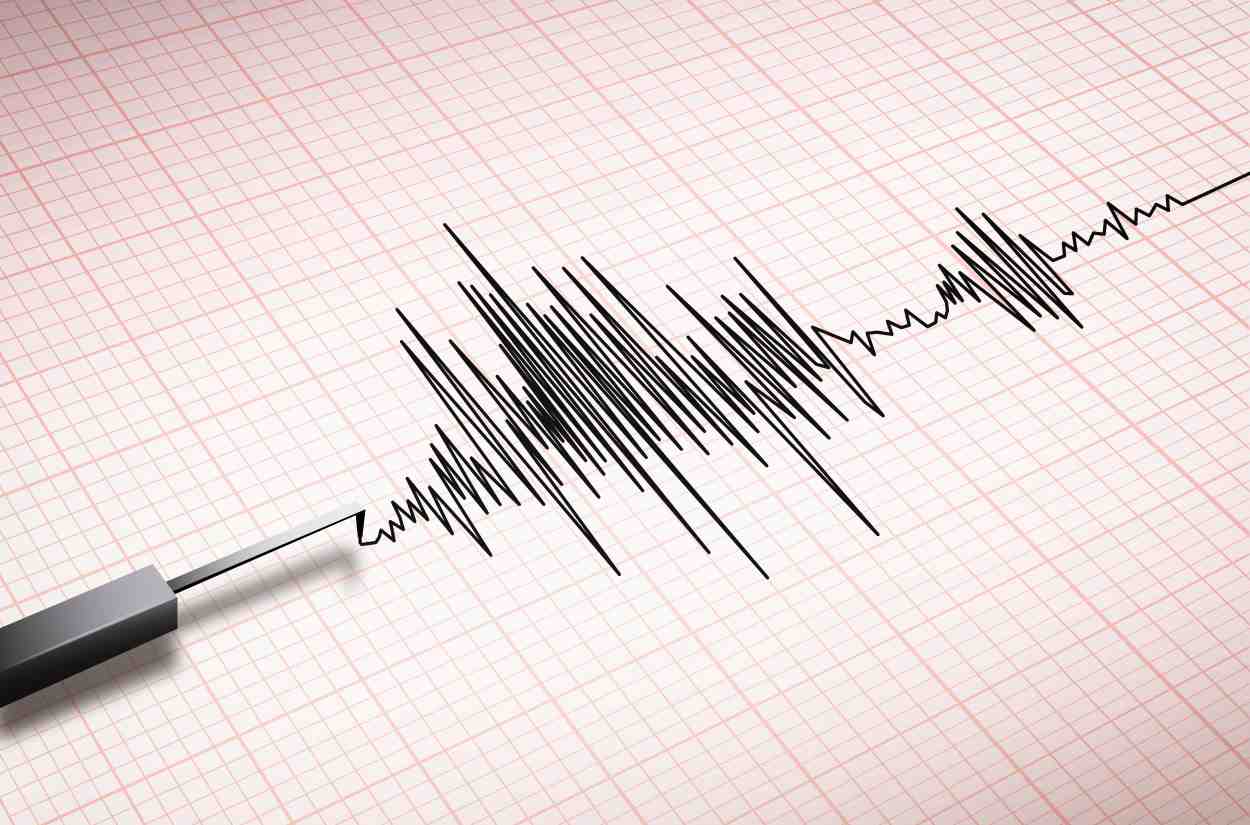
The magnitude is a number that characterizes the relative size of an earthquake. Magnitude is based on measurement of the maximum motion recorded by a seismograph. Several scales have been defined, but the most commonly used are:
    1. local magnitude (ML), commonly referred to as "Richter magnitude",
    2. surface-wave magnitude (Ms),
    3. body-wave magnitude (Mb),
    4. moment magnitude (Mw or M).
Most seismological authorities, such as the United States Geological Survey (USGS), report earthquake magnitudes as moment magnitude, which the press describes as "Richter magnitude".
Below are the tables for the effects of earthquakes and the class names:
| Magnitude | Effects |
|---|---|
| 2.5 or less | Usually not felt, but can be recorded by seismograph |
| 2.5 to 5.4 | Often felt, but only causes minor damage |
| 5.5 to 6.0 | Sligth damage to buildings or structures |
| 6.1 to 6.9 | May cause a lot of damage in very populated areas |
| 7.0 to 7.9 | Major earthquake. Serious damage. |
| 8.0 or greater | Great earthquake. Can totally destroy communities near the epicenter. |
| Class | Magnitude |
|---|---|
| Minor | 3 to 3.9 |
| Light | 4 to 4.9 |
| Moderate | 5 to 5.9 |
| Strong | 6 to 6.9 |
| Major | 7 to 7.9 |
| Great | 8 or greater |
Intensity scale

The PHIVOLCS Earthquake Intensity Scale (PEIS) is a seismic scale used and developed by the Philippine Institute of Volcanology and Seismology (PHILVOLCS) to measure the intensity of an earthquake.
PHILVOLCS cites seismic scale specifically developed for the Philippine setting, the different geography of each country and other "geological considerations" led to the development of PEIS.
The PEIS was adopted in the Philippines in 1996 replacing the Rossi-Forel scale.
The PEIS has ten intensity scales represented in Roman numerals with Intensity I being the weakest and Intensity X being the strongest.
| Intensity scale | Description | |
|---|---|---|
| I | Scarcely Perceptible | Perceptible to people under favorable circumstances. Delicately balanced objects are disturbed slightly. Still water in containers oscillates slowly. |
| II | Slightly Felt | Felt by few individuals at rest indoors. Hanging objects swing slightly. Still Water in containers oscillates noticeably. |
| III | Weak | Felt by many people indoors especially in upper floors of buildings. Vibration is felt like one passing of a light truck. Dizziness and nausea are experienced by some people. Hanging objects swing moderately. Still water in containers oscillates moderately. |
| IV | Moderately Strong | Felt generally by people indoors and by some people outdoors. Light sleepers are awakened. Vibration is felt like a passing of heavy truck. Hanging objectsswing considerably. Dinner, plates, glasses, windows and doors rattle. Floors and walls of wood framed buildings creak. Standing motor cars may rock slightly. Liquids in containers are slightly disturbed. Water in containers oscillate strongly. Rumbling sound may sometimes be heard. |
| V | Strong | Generally felt by most people indoors and outdoors. Many sleeping people are awakened. Some are frightened, some run outdoors. Strong shaking and rocking felt throughout building. Hanging objects swing violently. Dining utensils clatter and clink; some are broken. Small, light and unstable objects may fall or overturn. Liquids spill from filled open containers. Standing vehicles rock noticeably. Shaking of leaves and twigs of trees are noticeable. |
| VI | Very Strong | Many people are frightened; many run outdoors. Some people lose their balance. Very Strong - Many people are frightened; many run outdoors. Some people lose their balance. Motorists feel like driving in flat tires. Heavy objects or furniture move or may be shifted. Small church bells may ring. Wall plaster may crack. Very old or poorly built houses and man-made structures are slightly damaged though well-built structures are not affected. Limited rockfalls and rolling boulders occur in hilly to mountainous areas and escarpments. Trees are noticeably shakenmotorists feel like driving in flat tires. Heavy objects or furniture move or may be shifted. Small church bells may ring. Wall plaster may crack. Very old or poorly built houses and man-made structures are slightly damaged though well-built structures are not affected. Limited rockfalls and rolling boulders occur in hilly to mountainous areas and escarpments. Trees are noticeably shaken. |
| VII | Destructive | Most people are frightened and run outdoors. People find it difficult to stand in upper floors. Heavy objects and furniture overturn or topple. Big church bells may ring. Old or poorly-built structures suffer considerably damage. Some well-built structures are slightly damaged. Some cracks may appear on dikes, fish ponds, road surface, or concrete hollow block walls. Limited liquefaction, lateral spreading and landslides are observed. Trees are shaken strongly. (Liquefaction is a process by which loose saturated sand lose strength during an earthquake and behave like liquid). |
| VIII | Very Destructive | People panicky. People find it difficult to stand even outdoors. Many well-built buildings are considerably damaged. Concrete dikes and foundation of bridges are destroyed by ground settling or toppling. Railway tracks are bent or broken. Tombstones may be displaced, twisted or overturned. Utility posts, towers and monuments mat tilt or topple. Water and sewer pipes may be bent, twisted or broken. Liquefaction and lateral spreading cause man- made structure to sink, tilt or topple. Numerous landslides and rockfalls occur in mountainous and hilly areas. Boulders are thrown out from their positions particularly near the epicenter. Fissures and faults rapture may be observed. Trees are violently shaken. Water splash or stop over dikes or banks of rivers. |
| IX | Devastating | People are forcibly thrown to ground. Many cry and shake with fear. Most buildings are totally damaged. Bridges and elevated concrete structures are toppled or destroyed. Numerous utility posts, towers and monument are tilted, toppled or broken. Water sewer pipes are bent, twisted or broken. Landslides and liquefaction with lateral spreadings and sandboils are widespread. the ground is distorted into undulations. Trees are shaken very violently with some toppled or broken. Boulders are commonly thrown out. River water splashes violently on slops over dikes and banks. |
| X | Completely Devastating | Practically all man-made structures are destroyed. Massive landslides and liquefaction, large scale subsidence and uplifting of land forms and many ground fissures are observed. Changes in river courses and destructive seiches in large lakes occur. Many trees are toppled, broken and uprooted. |
Click a link below to show or display:
       PEIS poster (jpg file, display in a modal window)
       PEIS in Filipino (pdf file, open a new tab)
       PEIS in English (pdf file, open a new tab)
       Example of an earthquake alert (jpg file, display in a modal window)
    Sources:
         https://en.wikipedia.org/wiki/Seismic_scale
         https://en.wikipedia.org/wiki/PHIVOLCS_Earthquake_Intensity_Scale
         www.philvocs.dost.gov.ph