The two men who knocked on the front door of my friend's house wanted to witness to her. She assured them that she enjoyed a full and satisfying relatioship with God. She had repented of her sins, accepted Jesus Chris as Lord, and committed her life to him. She was happy with her present church affiliation and saw no need to look elsewhere.
That wasn't good enough, they told her. They grew upset because she couldn't see that God worked only through one special group-- theirs. They insisted that no one could be a true Christian except in their organization.
"Who are you," she finally asked them, "to tell Jesus Christ where he can or cannot work?"
This question, at last, silenced them. They could argue no further. They had witnessed, but had not won a new convert.
My friend is already converted. She is already a Christian.
Christian according to the Bible, claim allegiance to Jesus Christ. They believe in and on him. They accept him as their personal Saviour. They worship him as Lord and King.
Why, then, are different groups of Christians sometimes so hostile toward each other? Why are some unwilling to even consider the existence of "other Christians"?
One Body? Yes, But...
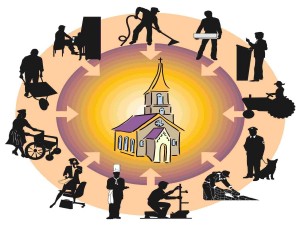
To be sure, Jesus himself flatly stated that not everyone who calls him "Lord, Lord" will enter the kingdom of heaven. One must do the will of the Father (Matthew 7:21).
And Ephesians 4:3-6 urges God's servants to "keep the unity of the Spirit," noting that there is "one body and one Spirit...one hope...one Lord, one faith, one baptism; one God and Father to all."
There is only "one body." But that one body is not a physical body or corporation. The New Testament witness is consistent: The true church of God is a spiritual community of believers.
"You, however, are controlled not by the sinful nature but by the Spirit, if the Spirit of God lives in you," the apostle Paul wrote to the Romans. "And if anyone does not have the Spirit of Christ, he does not belong to Christ" (Romans 8:9).
How, then, can you tell who is truly representing Christ, and who is not? Or...should we ask such a question?
At one time or another, I've been familiar with many different Christian groups-- mainstream, not-so-mainstream, large, small, emotional, emotionless, loving, cold.
As much as these groups differed, however, one trait that nearly all of them shared was a sense of exclusivity. Most felt that they were the one, true group of Christians. And many rejected and condemned "other Christians" who did not accept their particular doctrines, practices or cultures.
Like the men who called on my friend, most of the members of these groups were undoubtedly sincere and probably basically nice people. But their insistence that their physcal, corporate identity equaled, exactly, the spiritual body of Christ is unprovable scripturally.
Bible students know that the people of Israel fell into this trap. Israel closed in on itself and adopted an exclusivist, arrogant, even hostile posture towards other nations.
So did Jesus' own disciples, on occasion. Their attitude toward "others"-- and Jesus' evaluation of that attitude-- is recorded by Mark: "Teacher,' said John, 'we saw a man driving out demons in your name and we told him to stop, because he was not one of us.'
"'Do not stop him,' Jesus said. 'No one who does a miracle in my name can in the next moment say anything bad about me, for whoever is not against us is for us. I tell you the truth, anyone who gives you a cup of water in my name because you belong to Christ will certainly not lose his reward'" (Mark 9:38-41).
How to view "other Christians"? In short, leave them alone! It's not for any of us humans to tell Jesus Christ where he can or cannot work.
One of the earliest and most rancorous controversies in the New Testament church arose when God began to call Gentiles in the body of Christ. God shattered the Jewish members' exclusivist notions by demonstrating that he was working with the whole world, not just the Jews.
The apostle Peter finally realized that God does not show favoritism but accept all men and women who fear him and do what is right. The prophet testify that everyone who believe in Christ receives forgiveness of sins through his name.
Jesu said, speaking of non-Israelites: "I have other sheep that are not of this sheep pen. I must bring them also. They too will listen to my voice, and there shall be one flock and one shepherd" (John 10:16).
Later, Paul wrote: "Who are you to judge someone else's servant? To his own master he stands or falls. And he will stand, for the Lord is able to make him stand" (Romans 14:4).
"Other Christians," whoever they may be, are the servants of Christ, too. Christ takes responsibility for them. They must answer to him.

"But They Can't All Be Right!"
True. Nor can any one group or person be totally perfect, either. Some "others" even preach insincerely, for personal gain or other selfish reasons.
Paul, in prison, confronted just such a situation. Some had begun to preach Christ "out of envy and rivalry" (Philippians 1:15), perhaps to gain personal followings. But notice the position Paul took:
"The former preach Christ out of selfish ambition, not sincerely, supposing that they can stir up trouble for me while I am in chains. But what does it matter? The important thing is that in every way, whether from false motives or true, Christ is preached. And because of this I rejoice" (verses 17-18).
Paul rejoiced that Christ was preached, without regard ot the motives of the preachers. This was not an exclusivist Christian who warred over self-proclaimed turf or who worried whether "others" might, like him, have favor in God's eyes.
It's natural for us to want to restrict God's notice and blessing to ourselves. "Good fences make good neighbors," as the fencebuilder proclaimed in Robert Frost's poem "Mending Wall" (North of Boston, 1914). But Jesus is not inhibited by the limits of our physical fences. Christ envelops the whole world in his love and mercy.
And it is that godly love and mercy, more than any specific doctrine or practice or culture, that mark true Christians.
Are you like me? My own tendency toward exclusivism gets punctured every time I see "others," through selfless service, equal or excel my own efforts at glorifying God.
What business do I have claiming exclusive connection with God when the Bible tells me God is pleased by those who lay down their lives in love-- and displeased by those who self-righteously look down on others who serve him? The true neighbor, after all, was the "good Samaritan" who had mercy on the robbery victim. That is the standard Jesus set for us.
The question is not: "Where is the true church?" The question is: "Where is the true God?" We all need to find that God and worship him with our entire being.
Even the mighty Old Testament prophet Elijah made the mistake of believing that he stood alone in serving God. Fleeing from Jezebel's death threat, Elijah assumed that he was the only one left in Israel who did what God wanted.
God patiently explained to Elijah, "I reserve seven thousand in Isreal- all whose knees have not bowed down to Baal and all whose mouths have not kissed him" (1 Kings 19:18).
Whether Elijah was aware of it or not, God was working through many others in addition to him. This knowledge should have encouraged Elijah. Others worshipped God, too!
The Truth About "Others"
There are always others, in addition to us, who faithfully serve God as the Holy Spirit leads them. This fact should encourage us. Why should any of us be upset if someone else seeks God and strives to please him?
What makes Christians different? In the parable of the good Samaritan, two passed the robbery victim and did not help. Only later did a Samaritan stop to help.
Those who truly are "doers of the word" are few in number in any organization. They are like the few grains of salt that season food, and that's one of the metaphors Jesus Christ used for his disciples.
Only those who allow themselves to be led by the Holy Spirit belong to Christ. That means Christians are called to live, not according to the old, sinful nature, but the way Christ himself lived.
No human owns God, nor is God the property of any corporate entity or church. As Stephen said, "The Most High does not live in houses made by men" (Acts 7:48). Those were among the last words he preached before being stoned to death by some who didn't want to see the riches of God's grace given to others!
How does the old hymn "Onward, Christian Soldiers!" go? "We are not divided, all one body we; one in hope and doctrine; one in charity." Jesus said, "By this all men will know that you are my disciples, if you love one another" (John 13:35).
The fact is that there are no "other Christians"! There is only one kind-- those in whom Jesus Christ dwells, those who love God with all their hearts and who love their neighbors as themselves, those who glady submit to the Lordship of the one God who is sovereign and supreme over all.
by Norman L. Shoaf
There are always others who faithfully serve God as the Holy Spirit leads them. This fact should encourage us. Why should any of us be upset if someone else seeks God and strives to please him?